Backend systems & APIs
REST services, auth and roles, async workers and database-first design built to hold up under real traffic, not demo traffic.
DjangoFastAPIDRFCeleryWebSocketsPostgreSQL
I'm Yashvardhan — a freelance backend systems & AI engineer based in India. I build deterministic production architectures (Django, FastAPI, PostgreSQL, Redis) paired with grounded AI automation (PGVector RAG, LLM guardrails, automated decision mapping). I eliminate repetitive manual operations from team workflows — then prove business impact with exact, tracked operational metrics.

How I decide
Most of what arrives labelled as an AI problem is a workflow problem wearing a costume. I diagnose the process first, then pick the cheapest thing that holds: rules where rules work, models where the input is genuinely messy, and a person in the loop wherever a wrong answer is expensive to undo.
REST services, auth and roles, async workers and database-first design built to hold up under real traffic, not demo traffic.
Retrieval-grounded assistants, document extraction and lead qualification — with a prompt firewall in front and a strict schema behind.
Internal tools, dashboards, CRMs and admin systems — the unglamorous software a business actually runs its day on.
Infrastructure as code, CI/CD with tests and scans on every push, caching strategy and latency work — so releases become boring.
Eliminating database locks, N+1 query bottlenecks, and server crashes during flash sales and peak marketing surges.
26.6x Peak Capacity BoostCutting cloud waste, right-sizing databases, and implementing edge caching to lower monthly AWS bill by 60%+.
68.2% Infra Cost CutDeploying retrieval-grounded AI assistants and prompt firewalls to resolve repetitive customer inquiries with 0 hallucinations.
84.2% Support DeflectedContainerized Docker pipelines, Terraform IaC, automated rollbacks, and zero-trust security for 99.99% system availability.
99.99% Uptime SLAThe stack, by layer
In development
An operations-consulting client needed to turn qualitative organisational evidence — survey answers, interview notes, policy descriptions — into an auditable map of who actually decides what. That synthesis normally costs weeks of manual consulting. I'm building the pipeline that does it: extract atomic claims from free text, resolve everyone's different vocabulary onto one canonical taxonomy, infer decision ownership and required inputs, then hand an analyst a review workspace before anything ships. The model proposes, the evidence supports, a human still governs.
Selected work
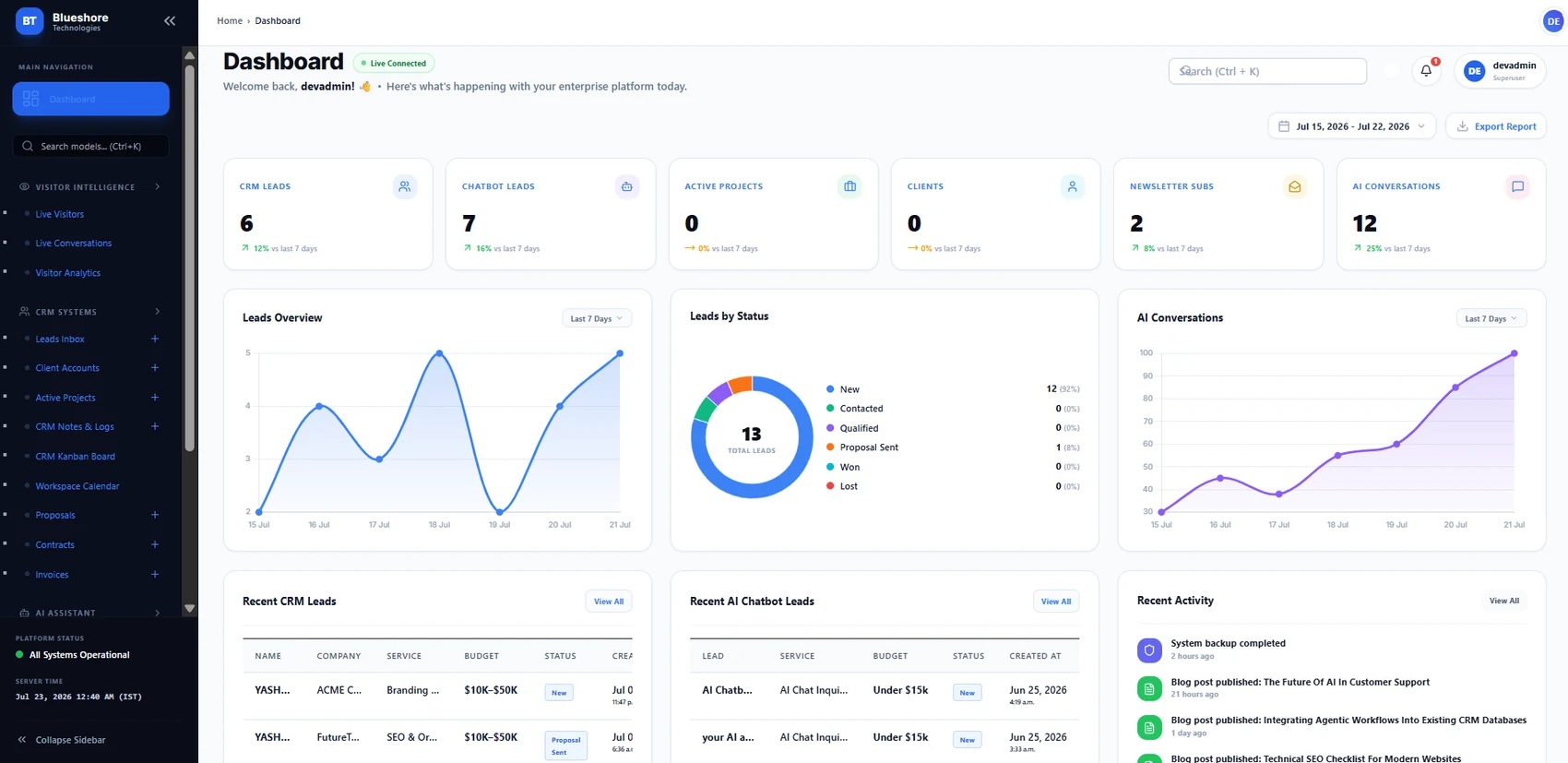
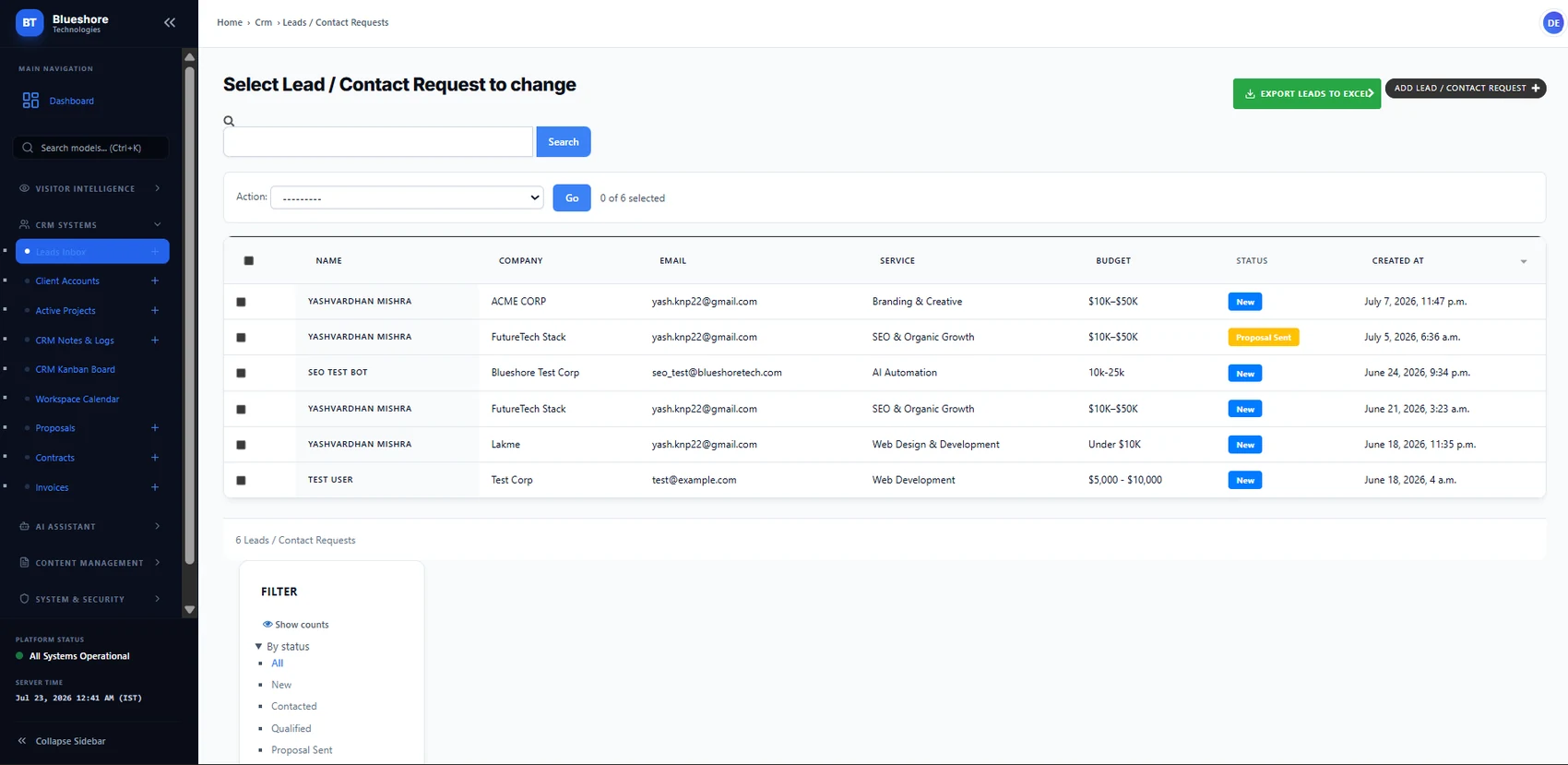
Blueshore is a B2B software and digital growth agency. They needed their own operating system: a CRM, a visitor-intelligence layer and an AI assistant that could capture and qualify leads without inventing answers. Sales signals were scattered across separate tools; I built the single platform that replaced them, end to end.
A contemporary menswear and womenswear house founded in 2016, with 200+ exclusive outlets across India. The brief was reach, not e-commerce: tell the brand story, open clean entry points into each collection, and let a shopper find the nearest store in two taps — on a phone, on a weak connection.
A tool that finds the AWS resources nobody is using and says what to do about them. FastAPI and Next.js, AI-driven cost recommendations, and a zero-trust IAM model so the scanner can read your account without ever being able to change it.
cloudpulse-chi.vercel.app →Inside the platform
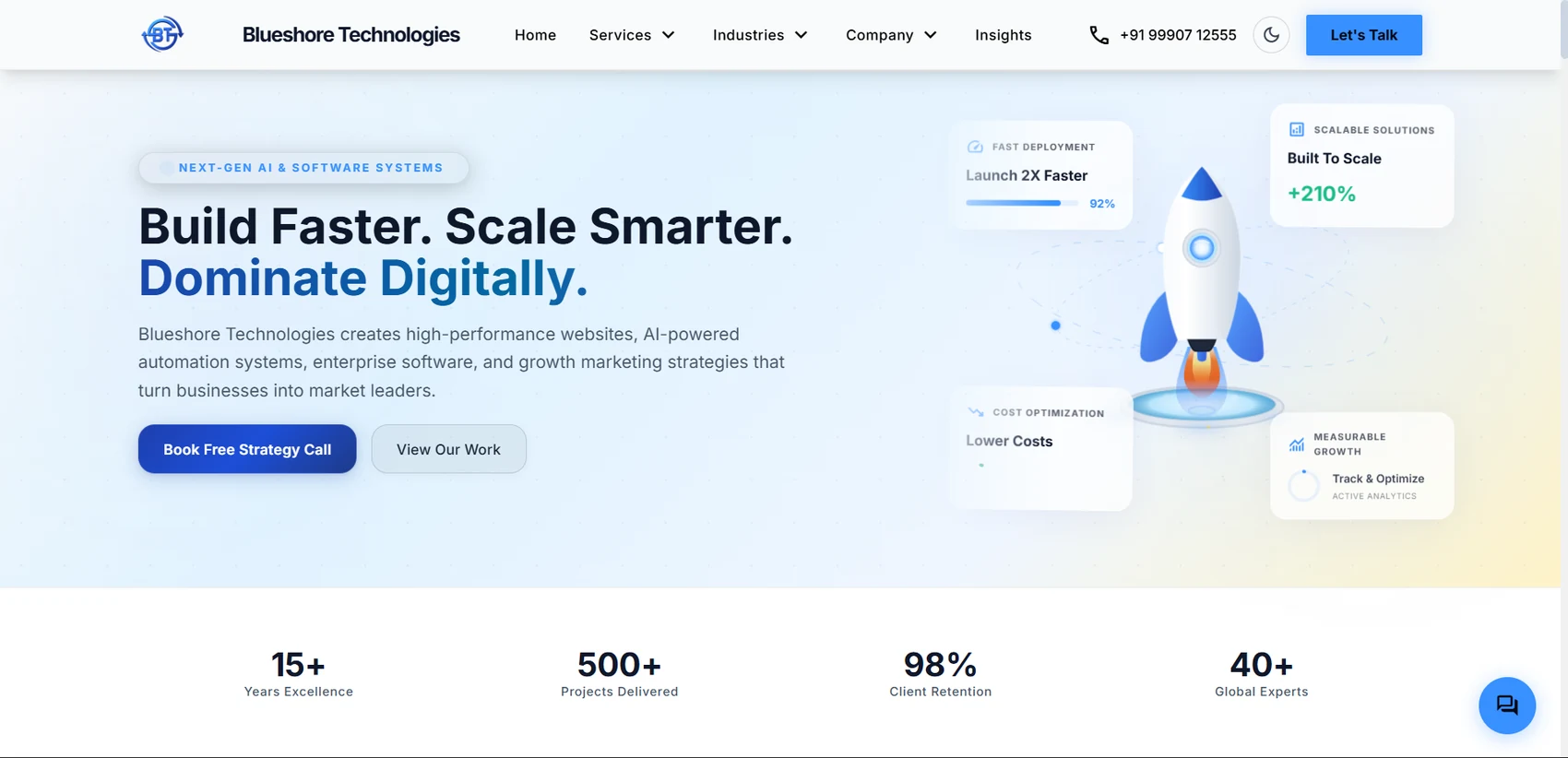
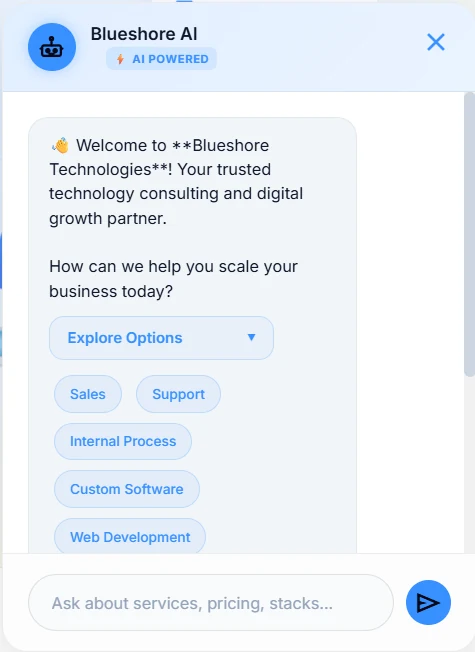
Screens from the Blueshore Technologies platform I built end to end — the operations dashboard, the CRM, the marketing site and the AI assistant. Click any screen to open it full size.
Architecture, documented
Handover documentation from the same platform. If the next engineer can't read how it works, it isn't finished.
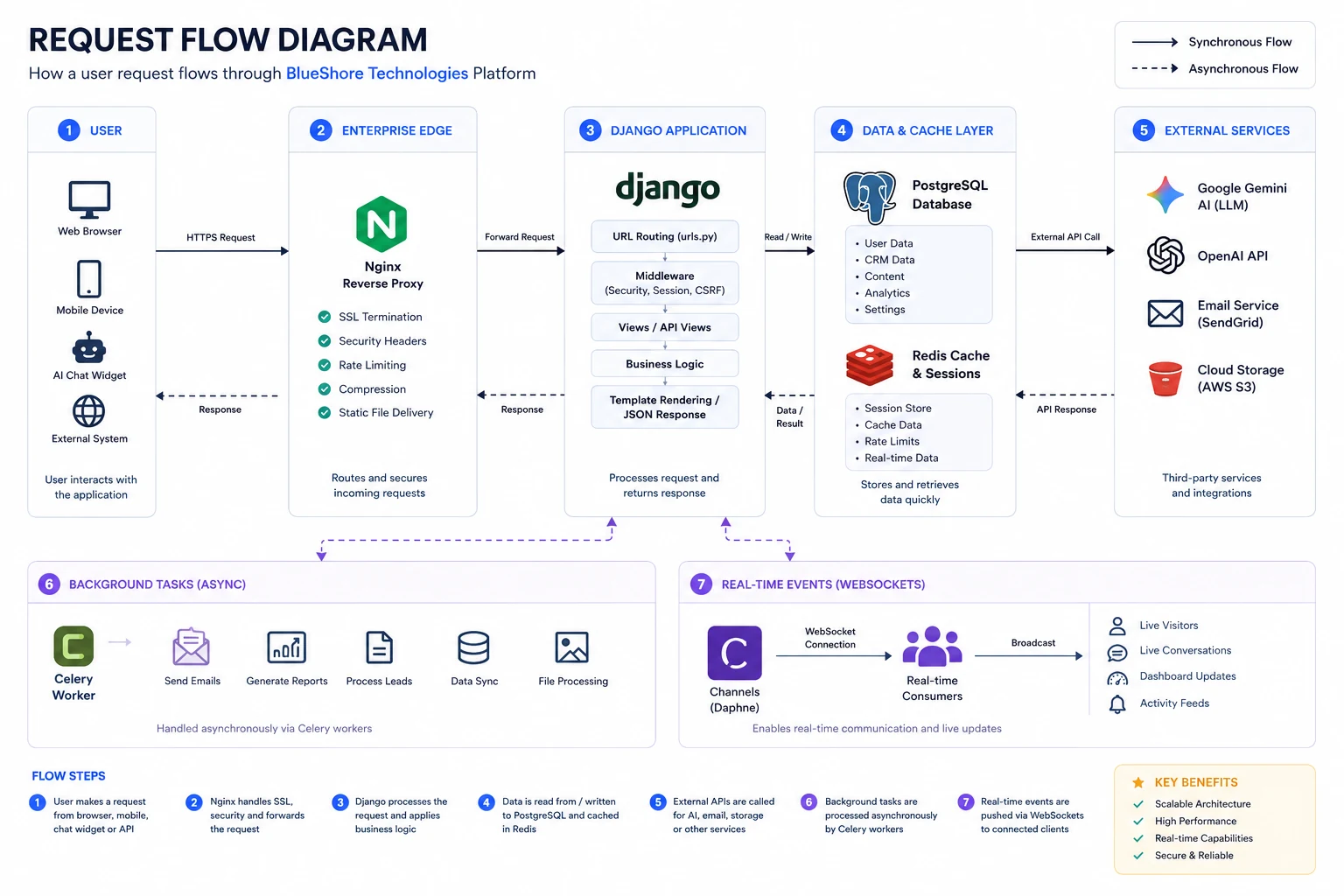
A single request traced end to end — Nginx terminating SSL and rate limiting, Django routing through middleware to business logic, PostgreSQL and Redis behind it, and the async paths where Celery workers and WebSocket broadcasts branch off.
Click to enlarge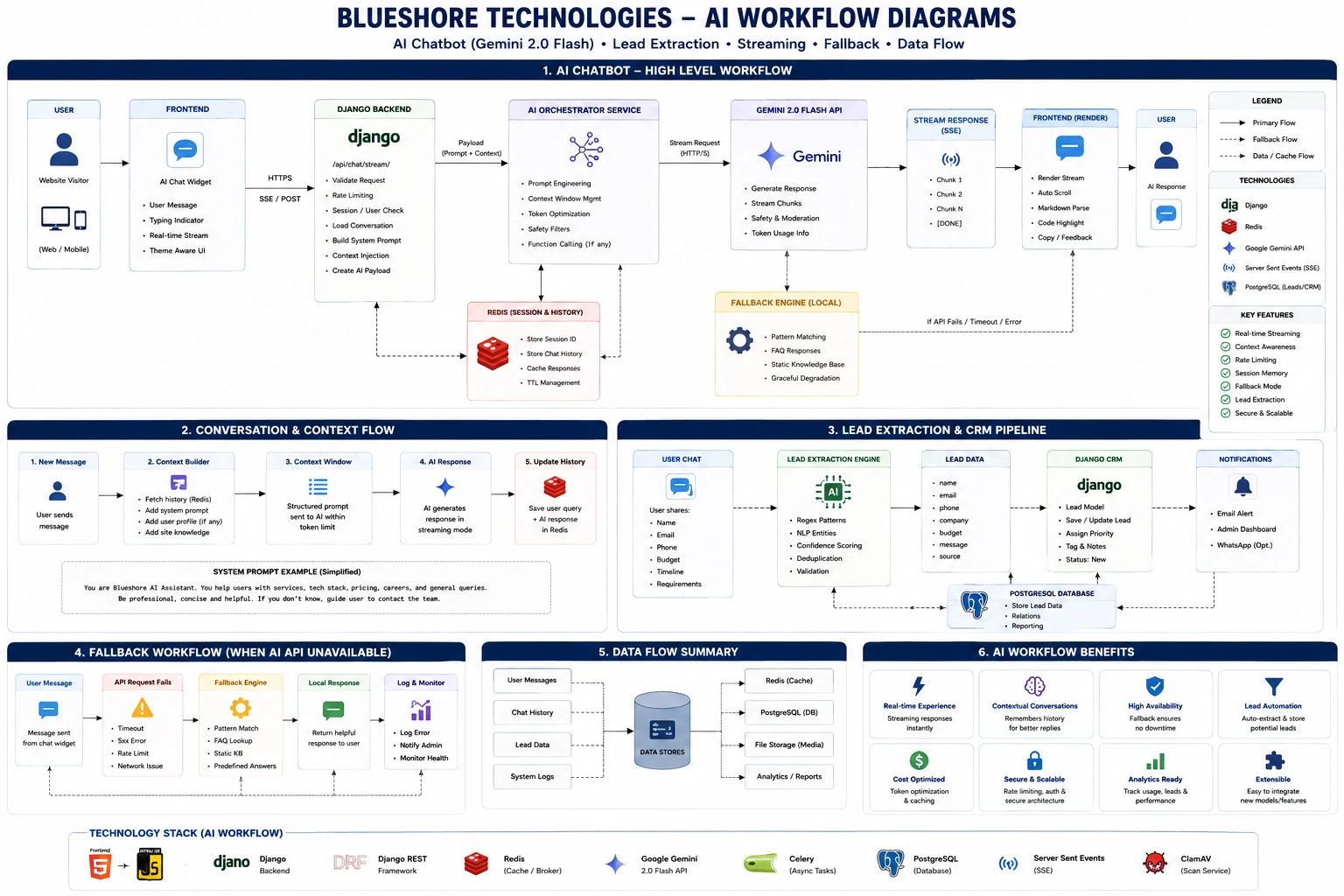
The assistant pipeline: prompt construction and rate limiting in Django, streaming responses from Gemini over server-sent events, entity extraction writing scored leads into the CRM — and the local fallback engine that keeps answering when the model API times out.
Click to enlarge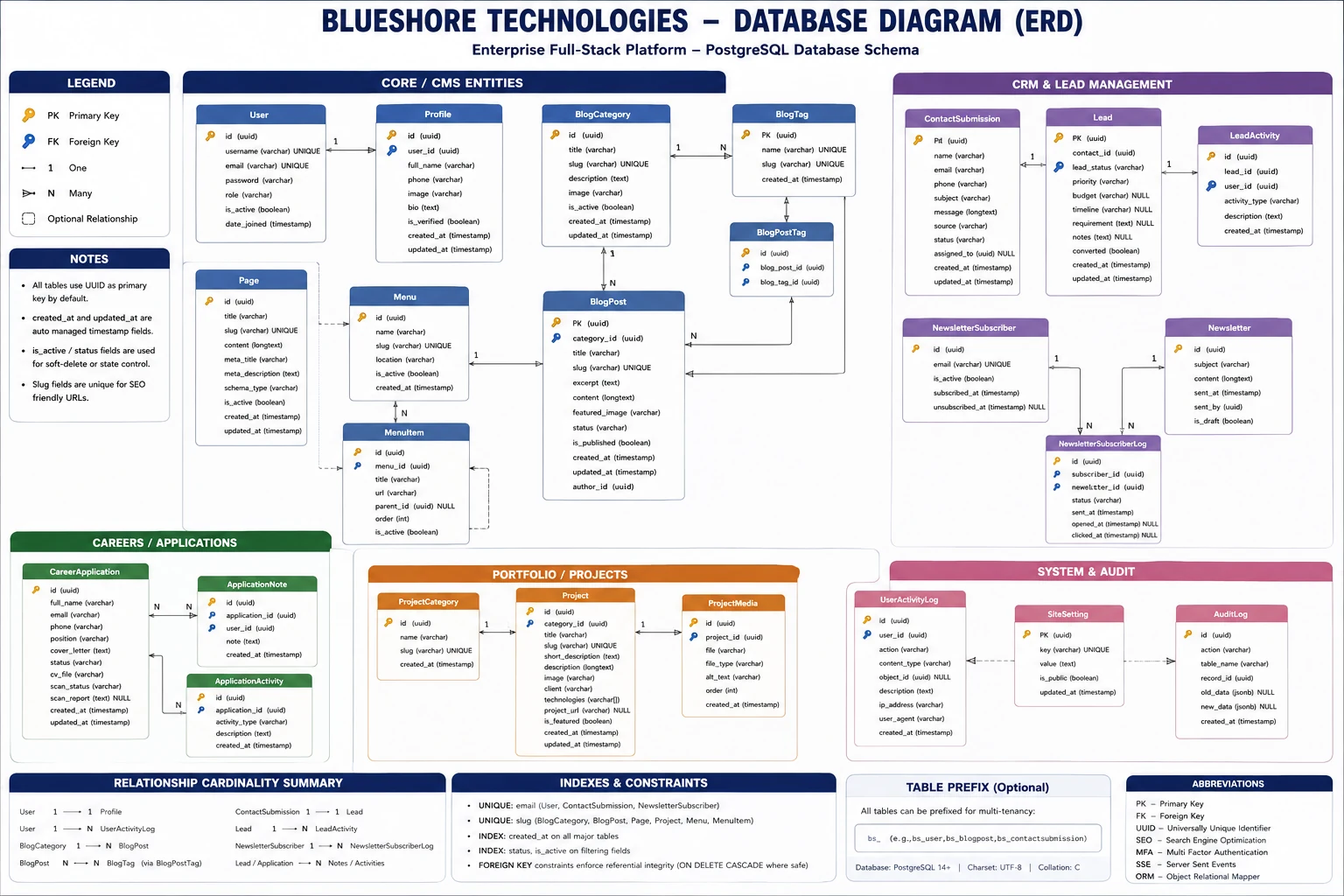
The PostgreSQL schema: UUID primary keys throughout, soft-delete state flags, unique SEO slugs, and cascade rules chosen table by table — CMS, CRM, careers and audit logging in one relational model.
Click to enlargeEngineering case studies
Pick the metric the business already feels. Move it. Keep the receipt. Delivered as a freelance engineer through Blueshore Technologies for their enterprise clients.
A legacy monolith on Python 2 buckling under 300% year-over-year signup growth. N+1 queries pushed response times past four seconds at market open, synchronous transaction processing blocked Gunicorn workers into 504s, and there was no centralised audit logging to survive a PCI-DSS review. I rebuilt the backend on Django 5 with read-replica routing, a Redis caching layer, and Celery workers handling invoice generation and webhook dispatch off the request path.
5,000 inbound tickets a month, a 14-hour first response, and 42% of high-value leads leaving before anyone called them back. This is the case where a model earns its place — but only behind guardrails. Input arrives over Django Channels with per-IP throttling, passes a prompt firewall that rejects injection attempts, then hits a PGVector retrieval step with a 0.82 similarity floor before Gemini is allowed to answer. Anything below the floor escalates to a person.
Every seasonal campaign ended the same way: inventory row locks during concurrent checkout, cascading crashes, and thousands of orders accepted for stock that no longer existed. I split the storefront into a Next.js head over Django REST catalog services, pre-rendered 95% of catalog pages with ISR so browsing never touches the database, and moved stock reservation into atomic Redis Lua scripts. Reads spread across three PostgreSQL replicas; the primary now does nothing but write.
Multi-tenant healthcare data spread across manually configured servers, three hours of scheduled downtime per release, and config drift quietly making staging lie about production. I codified every environment in Terraform, moved production databases and Redis into private VPC subnets with no route to the internet, and put a GitHub Actions pipeline in front of every push: 50+ tests, ClamAV scanning, container build, automated rollback on failure.
Who you'd be working with
I'm Yashvardhan Mishra. I started in enterprise delivery at Accenture, spent a year leading web application builds at Adviwe Media, and went independent in early 2026. Since then I've shipped CRMs, RAG assistants and cloud infrastructure for agencies and their enterprise clients.
Working with a freelancer usually means a handoff problem — one person scopes, another builds, nobody owns the deployment. I don't split it up. The person who writes your architecture doc is the person who takes the 2am page, which is a useful incentive for getting it right the first time.
"Send me the workflow, not the AI idea." — How every project starts
What clients say
"Yash was instrumental in bringing Blueshore's platform vision to life — from the CRM and AI assistant to the analytics layer. He communicated clearly, delivered on schedule, and consistently anticipated technical decisions before we had to raise them.
"He understood the brand before he wrote a line of code. The site is quick on a phone, the collections finally look the way they do in store, and customers can find their nearest outlet without hunting for it.
How an engagement runs
I review your current architecture, the pain points, and the business metrics we're aiming at.
A technical roadmap with fixed milestones and performance SLAs written down before anyone codes.
Two-week sprints with continuous Docker staging access and automated test reporting.
Zero-downtime deployment, documentation you can hand to the next engineer, and post-launch support.
Track record
Production SaaS in Python, Django, FastAPI, PostgreSQL, Redis and Docker. Enterprise chatbots, RAG systems, CRM platforms and workflow automation — engaged directly by agencies and their enterprise clients, from requirements through deployment and tuning. Currently lead architect and engineer on an LLM-based operational intelligence platform.
Backend systems and AI chatbot solutions. Built scalable Python APIs for production and shipped features quickly inside a cross-functional startup team.
Led end-to-end development of scalable web applications. Designed REST APIs, database schemas and automation workflows; mentored developers and ran code reviews.
Python REST APIs and automated deployment pipelines that cut release time by 30%. Integrated AWS EC2, S3 and IAM; resolved 50+ critical production issues.
Certifications: AWS APAC Solutions Architecture (Forage) · Foundations of UX Design · Software Design & Development Methodologies · Responsive Web Design.
Credentials & Learning
Next step
Send me the workflow — not the AI idea. I'll tell you what should be automated, where a model actually earns its place, and what it would take to build. No charge for that conversation.